
Executive Engagement vs. Account-Based Marketing: Where EE Fits in the ABM Pyramid
The DXC story that's still teaching the rest of us
Around the time CSC was becoming DXC Technology, a quiet revolution was happening inside the company's global marketing organization. Dorothea Gosling, who ran their ABM and Pursuit Marketing Center of Excellence from Zurich, and Nick Panayi, then Head of Global Brand and Digital Marketing, had built a discipline they called pursuit marketing, and they were winning awards for it.
DXC was a Boardroom Insiders customer at the time, and our ExecutiveIQ team, then operating as BI, had a front-row seat to what Dorothea and Nick were figuring out. The shorthand Nick used in a conference presentation nearly a decade ago is still memorable: pursuit marketing meant assigning "a mini-CMO" to each strategic deal. Dorothea drew it as a pyramid. Broad-based ABM at the base, narrowing as it climbed, with pursuit marketing at the very tip — reserved for the small number of accounts where the deal on the table was big enough to stand up a custom-built marketing operation around it.
The first big test came in 2016 when CSC signed an agreement to administer nearly seven million policies for a large insurer — the largest insurance BPS transaction of its kind in North America. CSC's CEO Mike Lawrie called it out on the next earnings call: "This win has established CSC as the largest provider of insurance BPS processing for life, annuities, and pensions in North America." The deal cracked open the entire insurance vertical for CSC. Pipeline expanded. Other insurers calling.
Dorothea's pursuit marketing program had just delivered the kind of proof point most marketing organizations spend a decade trying to manufacture. The sales team noticed. Demand for pursuit marketing support went from "convince me" to "when can we have it."
Almost ten years later, what Dorothea and Nick built is more relevant than ever — and most organizations still aren't doing it.
What is account-based marketing?
Account-based marketing (ABM) is a B2B go-to-market strategy that focuses marketing and sales resources on a defined set of high-value accounts, treating each account (or cluster of accounts) as a market of one. Instead of running broad demand-generation campaigns aimed at anyone who fits an ideal customer profile, ABM teams identify named accounts and orchestrate coordinated outreach across marketing, sales, and customer success.
ABM scales. A well-run ABM program can cover hundreds of accounts with tiered levels of intensity — heavier investment in the top tier, lighter touch as the tiers expand.
What is executive engagement?
Executive engagement (EE) is intentional, orchestrated, sustained relationship-building between a company's executives and the executives at its most strategic customers and prospects. It encompasses Customer Advisory Boards; Executive Briefing Centers; curated one-to-one meetings; high-touch, exclusive CXO events; sponsored experiences; and the deep intelligence work and careful outreach that makes any of those things land.
EE is not a campaign. It's a long game, and it requires its own discipline, its own intelligence, and its own dedicated owner.
The relationship between ABM and EE: it's a pyramid, not a binary
Executive engagement isn't an alternative to account-based marketing. It isn't a separate discipline that competes with ABM for budget. It's an element of ABM — the element reserved for the accounts where the stakes justify it.
Dorothea's pyramid is still the cleanest way to think about it:
At the base: broad ABM, covering a large set of named accounts with tiered, scalable plays.
In the middle: strategic ABM, with deeper personalization and more investment per account.
At the tip: pursuit marketing or executive engagement, reserved for the handful of accounts where a major deal is on the table or where the long-term revenue justifies a custom-built relationship strategy.
Not every account in an ABM program gets executive engagement. They shouldn't. The math doesn't work, and the executives on your side of the table don't have the bandwidth. But for the accounts at the tip of the pyramid — the mega deals, the strategic logos, the customers whose advocacy will move other deals — broad ABM motion isn't enough. Those accounts need something built around them, not pushed at them.
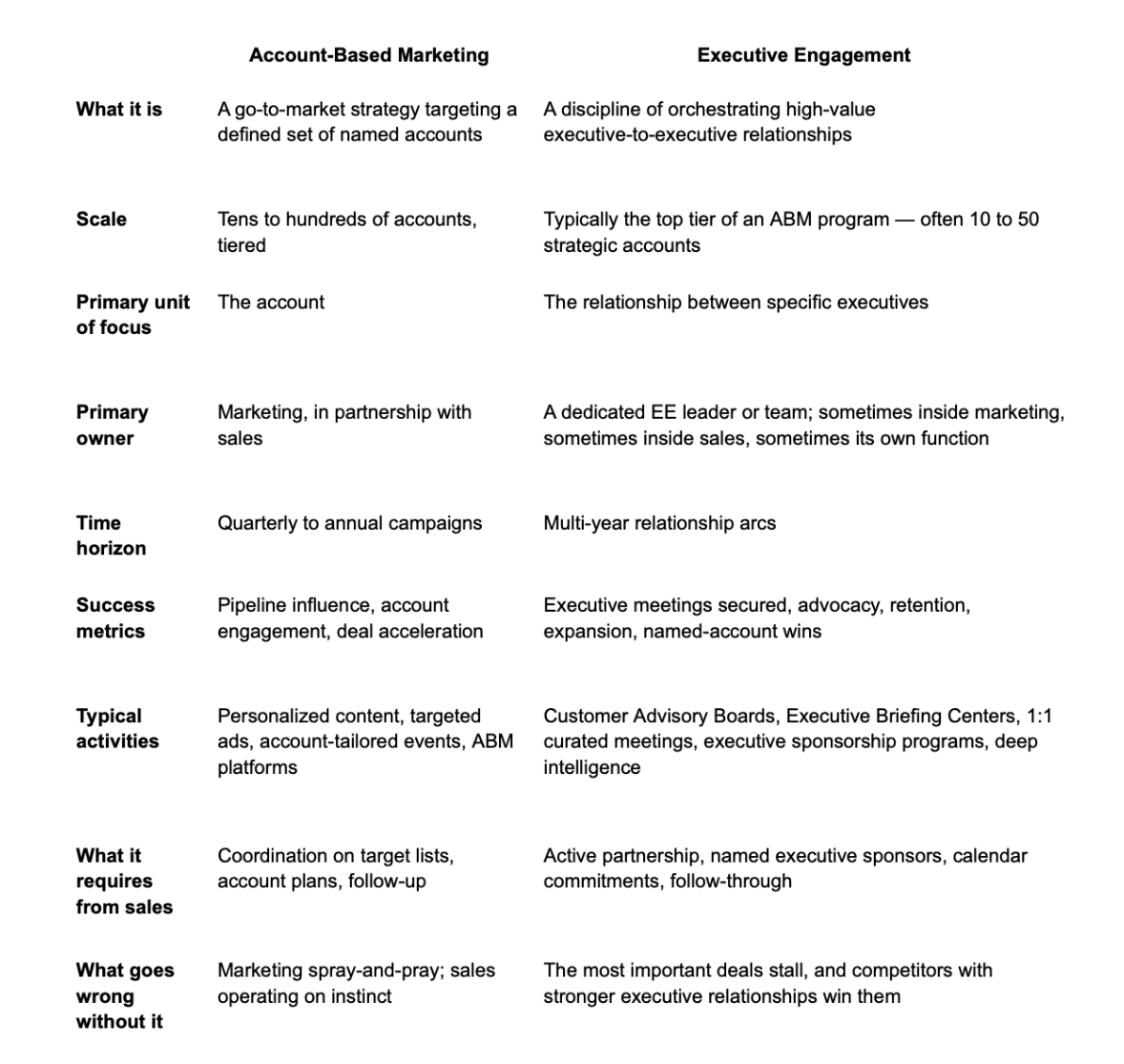
Executive engagement vs. account-based marketing: a side-by-side comparison
EE and ABM are designed to work together. The mistake organizations make is either running ABM without ever climbing to the tip of the pyramid — leaving the most strategic accounts under-served — or running an executive engagement program disconnected from the broader ABM strategy, which leaves the EE team without infrastructure or reach.
The lessons from DXC that still apply
What Dorothea built at DXC is a workable template for how ABM and EE work together to deliver results. Three lessons stand out a decade later and they're still rare.
1. Sales-marketing partnership wasn't optional. It was a precondition.
Dorothea's rule was that pursuit marketing only kicked in when the account team was fully engaged and willing to work in true partnership with marketing. Not as an audience. Not as a stakeholder to be looped in. As a co-owner of the pursuit, with executive sponsors named on both sides and a shared definition of what winning looked like.
This is where most ABM and executive engagement programs break down today. Marketing tries to run an EE program without sales engagement, and the program produces beautiful events that don't convert into pipeline. Or sales tries to engage executives without the intelligence and orchestration that marketing can bring, and the outreach lands flat. The DXC model required both, or the work didn't happen.
2. It was reserved for accounts where the stakes justified the investment.
Pursuit marketing wasn't sprinkled across the account base. It was reserved for accounts where a major deal was actively on the table — accounts where a dedicated, hand-crafted, executive-led marketing operation could meaningfully change the outcome. That discipline of scarcity is what made the model work. Everyone knew that getting pursuit marketing assigned to your account meant the company was going all-in. Measuring success was refreshingly easy: you either won the deal or you didn’t.
Organizations today often try to apply executive engagement broadly, and the dilution kills the program. Done well, EE is expensive per account. Doing it for accounts that don't warrant it wastes the resource and dilutes the brand of the program internally.
3. Early proof points created internal demand.
The insurance giant win wasn't just a deal. It was an internal proof point that gave the program oxygen for years afterward. Sales teams that had been skeptical became evangelists. Other vertical leaders asked when they could have their own pursuit support. The program scaled because it earned the right to scale, not because someone in marketing leadership declared that it should.
This matters for any organization standing up an executive engagement function today. Start with the accounts where you have the highest probability of a marquee outcome. Get the win. Then expand.
Why this matters now
The reason this distinction matters more in 2026 than it did in 2016 is that broad ABM motion is now within reach of almost anyone. AI tools have made personalized content, targeted outreach, and account-tailored campaigns radically more accessible. The cost of running a competent baseline ABM program has collapsed.
Which means the baseline is no longer a competitive advantage. Everyone has it.
What hasn't collapsed in cost — and what still separates the companies winning the biggest deals from everyone else — is the executive engagement layer at the tip of the pyramid. The hand-crafted, human-centric, deeply intelligent, sales-marketing-aligned, executive-to-executive relationship work that AI can support but not replace.
That's the layer ExecutiveIQ was built for. The intelligence infrastructure that lets EE teams orchestrate at scale without losing the depth that makes the work matter. Powered by AI. Perfected by People.
ABM gets you to the named-account list. Executive engagement is how you win the accounts at the top of it.
P.S. If you're standing up an executive engagement function — or trying to figure out how to make the one you have actually land — we should talk.