ExecutiveIQ vs. LinkedIn Sales Navigator
The best enterprise sellers already know what everyone else is still figuring out: LinkedIn Sales Navigator isn't enough and never has been — not just for the meeting itself, but for getting the meeting in the first place. Executives are bombarded with outreach from sellers who all sound the same. The only way to break through is to lead with something that makes them stop and think, wait — this person actually understands what I'm dealing with and might be able to help.
For that, you need a lot more than a name, a title, and a bio. You need executive intelligence.
What is executive intelligence?
Executive intelligence tells you what a specific executive cares about, what they're dealing with right now, what they've said publicly about their priorities and leadership style, and who can get you in the room. It's synthesized from dozens of source types — earnings calls, annual reports, press coverage, speeches, LinkedIn posts, podcast appearances — and because the stakes are high, it should be vetted by human analysts with strong business acumen.
It's everything LinkedIn doesn't tell you about the person on the other side of the table.
And while AI can sometimes surface what you need, the sheer volume of the open web, the reality that executives share names, and the fact that LLMs routinely miss key documents like earnings call transcripts and investor-day remarks mean that accuracy still requires a human in the loop. Someone has to check that the information is current, correctly attributed, and that no stone has been left unturned.
Is LinkedIn Sales Navigator enough for enterprise selling?
No one is questioning the value of LinkedIn Sales Navigator. Every enterprise sales team should have it. It gives you the name, the title, the career history, the connections. It's how you find the right people, track job changes, and stay on top of your accounts.
But here's the thing: so does everyone else.
When you're trying to get 30 minutes with a Fortune 500 CXO, "I see you're the new CISO at Abbott" isn't going to cut it. That person has heard that opener 40 times this week. To break through, you need to know what they're actually dealing with: what's keeping them up at night, what they told investors last quarter, what they're integrating, what they're shutting down, and who in your network can get you in the room.
That's what executive intelligence is. And that's what ExecutiveIQ provides — on top of LinkedIn, not instead of it.
There's also a fundamental data quality issue. LinkedIn profiles are self-reported — they can be incomplete, out of date, or simply wrong. We see this regularly: people listed in roles they left a year ago, missing board affiliations, gaps in career history. Sometimes the person is no longer at the company. Occasionally, they're deceased. LinkedIn is a valuable starting point, but it's not a verified source — and treating it as one is how sellers walk into meetings with bad information.
What’s the difference between LinkedIn and ExecutiveIQ?
LinkedIn goes wide and shallow, covering pretty much everyone in business. ExecutiveIQ goes narrow and deep on senior-level executives. EIQ profiles cover what an executive is focused on strategically — drawn from earnings calls, conference appearances, interviews, and press coverage — along with board and advisory roles, nonprofit involvement, personal interests, public quotes and positions, and leadership style. These profiles are built to answer the question every seller has the night before a big meeting: Who is this person, what do they care about, and how do I earn credibility in the first five minutes?
We use AI to scan thousands of sources and extract structured data, then put human analysts in the loop to verify facts, catch errors, and fill in what automation misses. We triangulate across earnings calls, press coverage, regulatory filings, conference appearances, and board records because no single source is reliable on its own. An executive profile that says someone sits on a board they left two years ago doesn't just fail to help; it destroys the credibility you are trying to build.
But we believe in “show, not tell.” To show the difference in practice, we pulled up three real executives on both LinkedIn and ExecutiveIQ.
What does ExecutiveIQ show that LinkedIn doesn't?
Kaes Van't Hof — CEO, Diamondback Energy (Fortune 500)
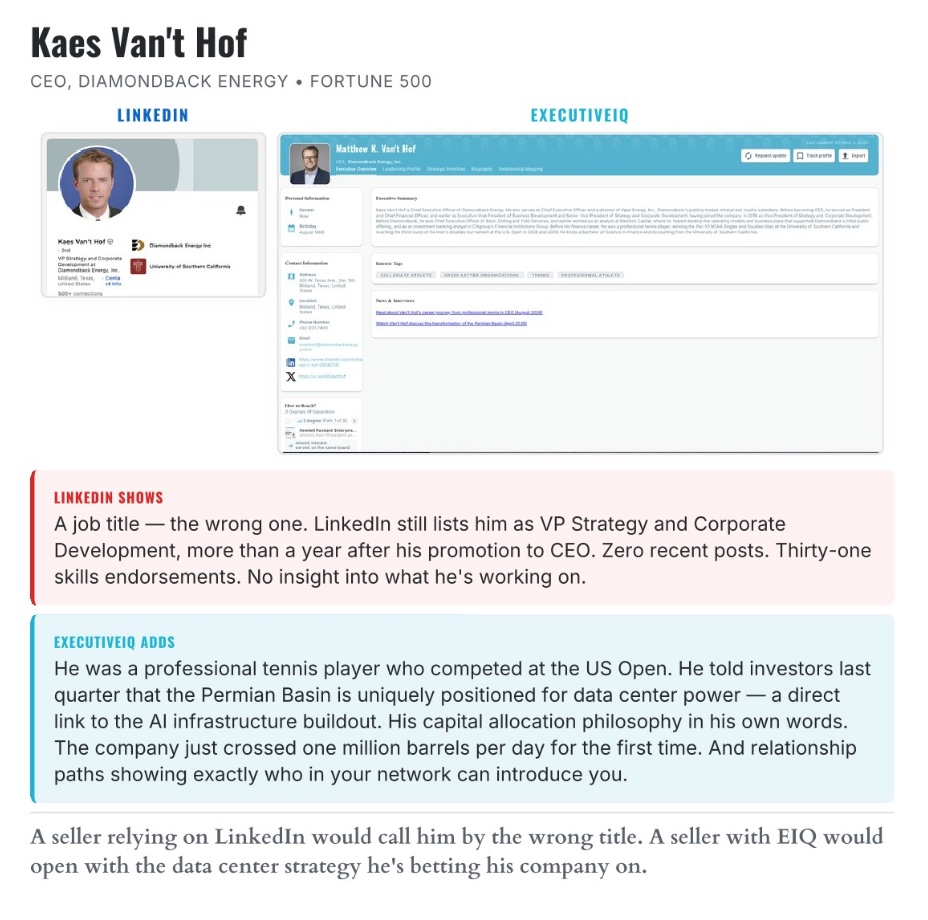
LinkedIn versus ExecutiveIQ
Chris Tyberg — CISO, Abbott Laboratories (Fortune 500)
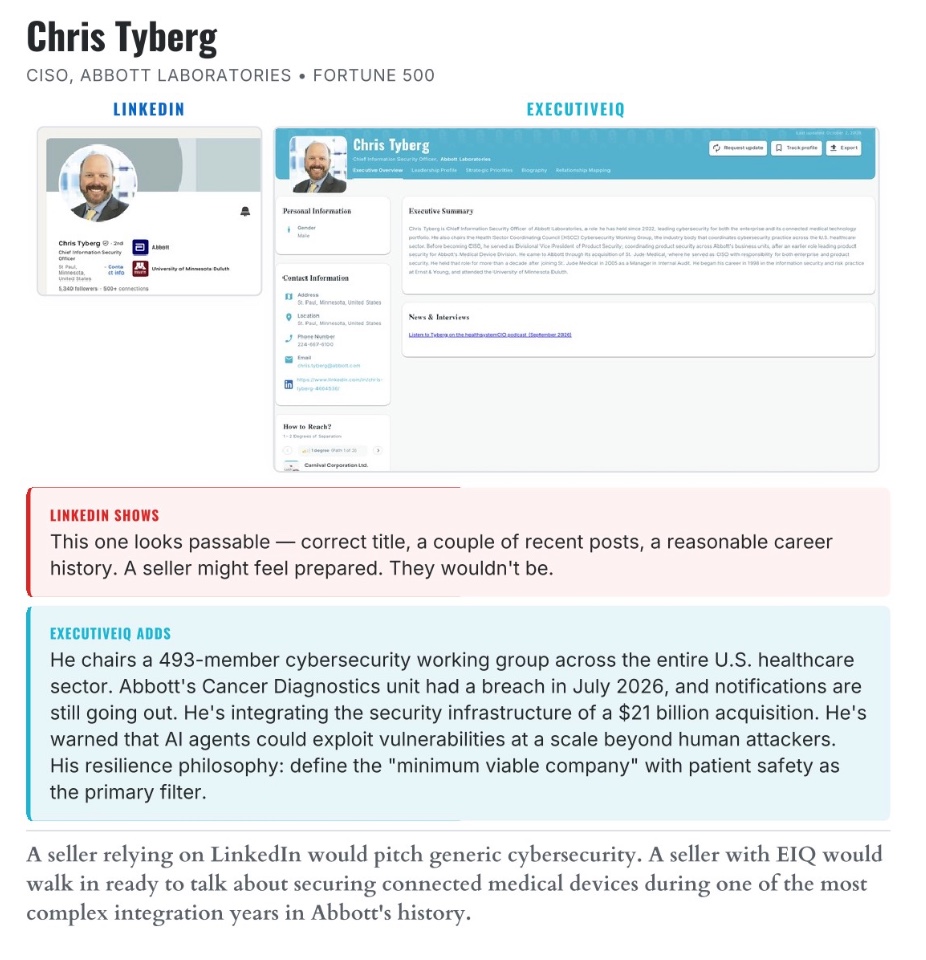
LinkedIn versus ExecutiveIQ
Eben Albertyn — EVP & CTO, EchoStar Corporation
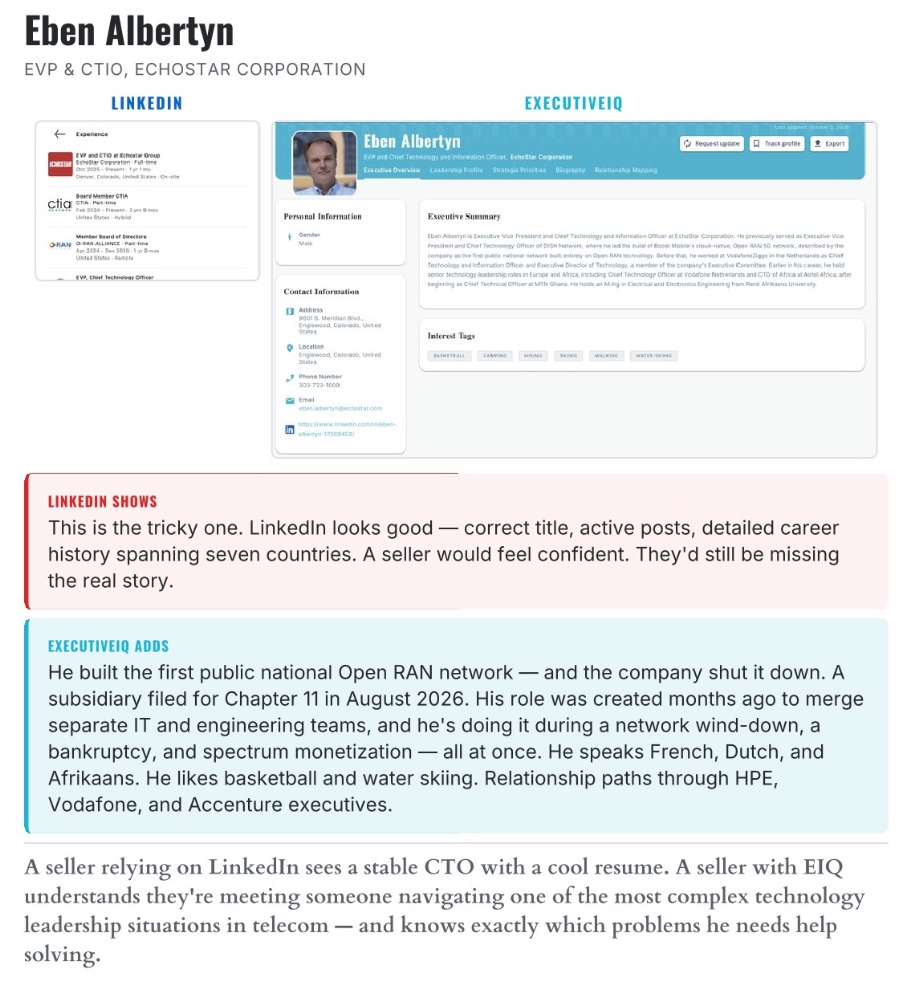
LinkedIn versus ExecutiveIQ
How does ExecutiveIQ find the warmest path to any executive?
Every ExecutiveIQ profile includes a "How to Reach" section — and here's what makes it different from LinkedIn's connection count: it's personalized to your company.
When you're logged in, ExecutiveIQ finds the warmest path between your organization and the executive you're trying to reach. It doesn't just tell you a path exists — it shows you why: they served on the same board, worked at the same company during the same years, or studied at the same school. It will also show if they share the same hobbies and interests.
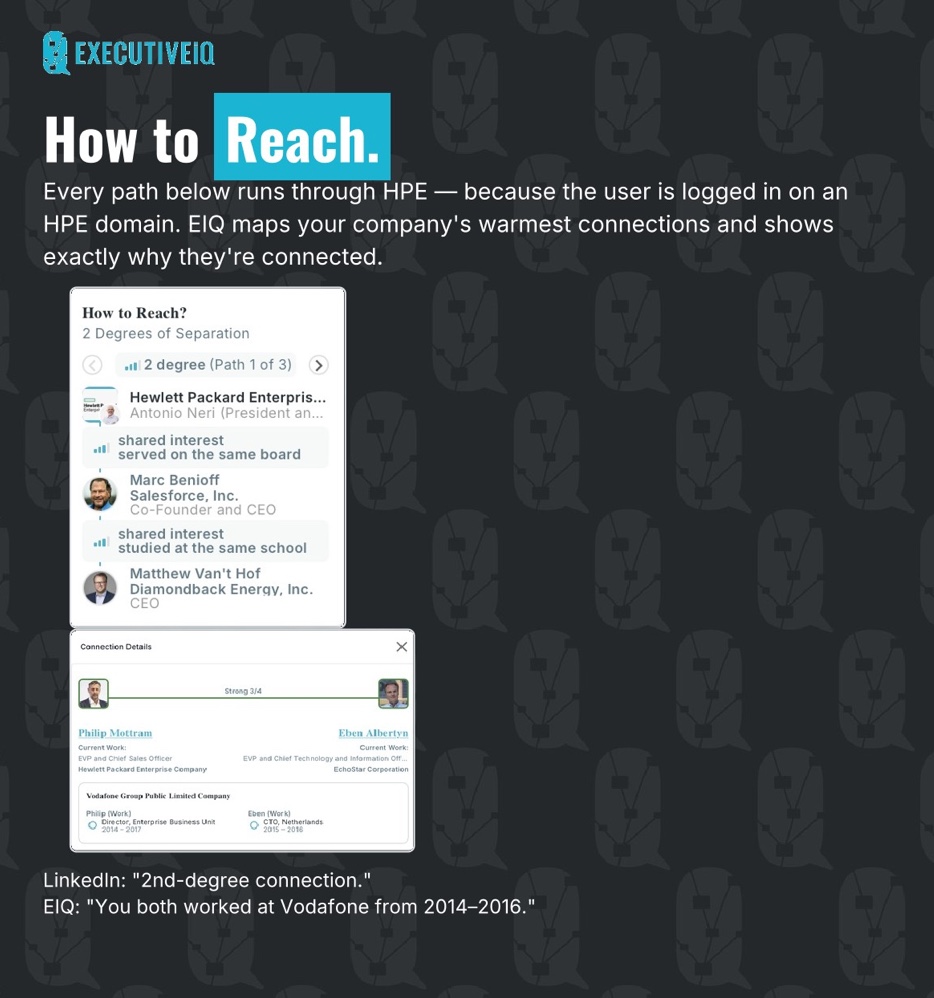
ExecutiveIQ Relationship Mapping
LinkedIn tells you someone is a 2nd-degree connection. ExecutiveIQ tells you that your colleague Philip and the executive you're targeting both worked at Vodafone during overlapping years — so when you ask Philip for the introduction, you don't say "can you introduce me?" You say "you two overlapped at Vodafone — would you be open to making an introduction?" That's the difference between a cold ask and a warm one.
How do ExecutiveIQ and LinkedIn Sales Navigator compare?
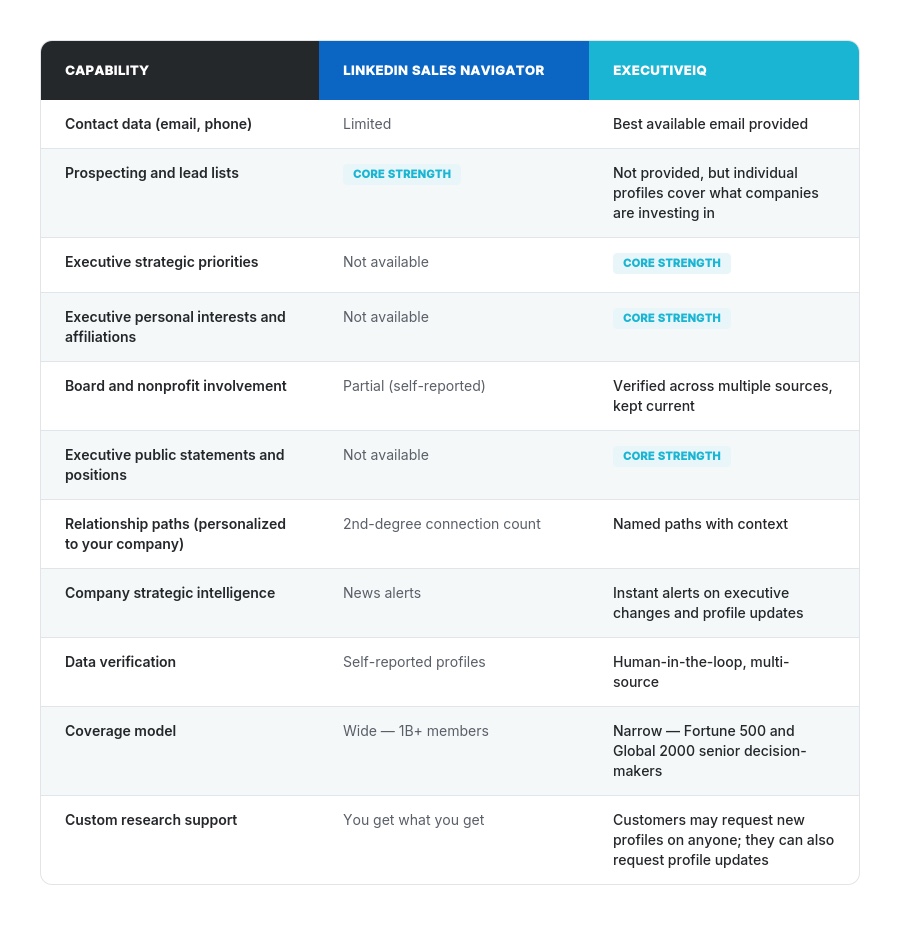
Comparison of LinkedIn and ExecutiveIQ’s Product Features and Capabilities
So do you need ExecutiveIQ if you already have LinkedIn Sales Navigator?
It depends on which problem is costing you more deals.
If your problem is finding the right people and getting in front of them, Sales Navigator is the right tool. It's built for prospecting, and it's very good at it.
If your problem is that you're not getting in front of the right people and not advancing deals, that's a preparation problem, not a prospecting problem. Your sellers aren’t able to get in the room with the right people and/or they don't have the context to make the conversation relevant to what those people care about. That's where executive intelligence comes in.
The strongest enterprise teams use both. Sales Navigator to find and connect. Executive intelligence to prepare and close.
LinkedIn gets you a name. ExecutiveIQ gets you in the door and helps you close the deal.
Powered by AI. Perfected by People. See what ExecutiveIQ can show you about the executives you're trying to reach at executive-iq.com.