How to Turn Executive Profiles into a Complete Event Strategy — in Under an Hour
Your company just landed eight VIP hospitality passes for a major sporting event — the Olympics, a Formula One race, a PGA championship. The guests: eight Fortune 500 CHROs your sales team has been trying to reach for months. You have four weeks. Now what?
Not the logistics. The strategy. Who sits next to whom. Which of your own leaders has a genuine personal connection to which guest — and what that connection actually is. Which product to lead with for each account. Whether anyone on your team shares an alma mater, a board seat, or a trade-association membership with the people across the table. And whether anyone in the group played the sport they’re about to watch together.
Even in the age of AI, most sales teams answer these questions the hard way: days of manual research across LinkedIn, proxy filings, earnings transcripts, and news searches — per person. Multiply that by fourteen (eight buyers plus your own leadership team), and you’re looking at a week of analyst time before anyone writes the first outreach email.
We built the entire playbook in under an hour.
What “Under an Hour” Actually Means
We started with ExecutiveIQ profiles on all fourteen executives — eight target CHROs and six of the client’s own senior leaders.
These aren’t LinkedIn summaries. Each profile is a complete picture of who the executive is, what they care about, and what’s happening at their company right now — career history, education, board affiliations, personal interests, and current business priorities pulled from SEC filings, earnings call transcripts, proxy statements, and public disclosures.
Many of these CHROs have never given a public interview or published a single thought-leadership piece. That doesn’t slow us down. A CHRO’s priorities don’t live only in their own words. They live in what the CEO told analysts about the company’s AI investment on last quarter’s earnings call. In the workforce-restructuring language buried in the 10-K. In the new Chief AI Officer appointment that just hit a proxy filing. ExecutiveIQ reads all of those filings through the lens of that specific HR leader’s responsibilities and connects the dots back to them — so even an executive who’s never been quoted has a rich, detailed profile tied to real, verified data.
We exported those profiles and fed them to an AI tool with a single prompt: Build me an event strategy playbook for this cohort, mapped to our product line and this specific sporting event.
What came back — after light editorial cleanup — was a playbook with six actionable sections. Here’s what each section delivered.
1. Which Product, Which Executive, and Why Right Now
The AI matched each CHRO’s company against the client’s product line and ranked all eight accounts by how strong the fit was, right now.
This wasn’t generic persona matching. It pulled specific, real-world signals: a publicly stated goal to build a 50,000-person skilled-trades pipeline by 2030 — almost exactly what the client’s talent-pipeline product does. A pending acquisition creating an urgent need for licensed healthcare workers. An internal analytics tool that signals appetite for exactly the kind of workforce benchmarking the client sells.
Some of those signals came from the executive’s own public statements. Most came from earnings calls, investor presentations, and SEC filings where the CEO or CFO described workforce priorities that map directly to the CHRO’s remit.
Two of the eight accounts turned out to be near-perfect fits today; the executives’ companies were already describing the exact problem the client’s product solves. The sales team hadn’t connected those dots because the information was scattered across a dozen different sources. The profiles had it all in one place.
2. Who Knows Whom — and How to Reach Them
This is where the data did something no amount of manual research could replicate quickly.
ExecutiveIQ’s relationship-mapping feature — How to Reach — was scoped to the full fourteen-person set. It surfaced three tiers of connection:
Direct personal connections. One executive on the client’s team shared three documented personal interests with one of the target CHROs. Seating them side-by-side was a no-brainer.
Institutional bridges. Two of the client’s leaders and two of the target CHROs serve at the same trade association — on overlapping committees. They could plausibly be in the same room at the next event. The playbook flagged this as a stronger path than a standard sales introduction, and recommended a specific client executive to make the approach.
Alumni and insider paths. The mapping found named executives inside the target companies who share an alma mater or a documented interest with someone on the client’s team. Not “you both went to a Big Ten school.” Specific: a named CTO at the target company who sits on the same leadership team as the CHRO, and who shares both an interest and a university with the client’s COO. That’s a warm internal introduction — far better than a cold LinkedIn message to the CHRO directly.
The result: every one of the eight target accounts had at least one documented relationship bridge. Not a guess. A real, profile-sourced connection.
3. Patterns You’d Never See One Profile at a Time
Here’s what changes when you look at an entire cohort instead of researching executives individually.
Several CHROs in the group started their careers far from HR — one began as a frontline sales trainee, another as a bank retail service officer. The client’s own commercial leader had a parallel story, having built apprenticeship programs for first-generation workers. That’s not something a sales rep would ever find in pre-call research on a single executive, but it’s obvious when the profiles are side by side.
Other patterns: multiple executives across both groups care about women-in-leadership programming. Several are serious runners. Two share a niche fitness-community affiliation. These overlaps are genuine and perfect for building rapport — but no one would look for shared interests across fourteen people at once without the data already organized to surface them.
4. A Sport-by-Sport Hospitality Plan
This is where the event context made everything specific.
The client sponsored a multi-sport international event. Several of the target CHROs had real athletic backgrounds — a former Division III All-American, a former professional athlete, a varsity letterwinner. The AI matched each executive’s sports background to specific events within the sponsorship and ranked the invitations by how closely the match tied to something verifiable in the profile.
The best invitations weren’t generic VIP passes. They were personal: a former softball player invited to a softball showcase. A football enthusiast invited to a flag football exhibition. A competitive swimmer paired with a swim event. And each one extended by the specific client executive who shared the closest personal connection.
Where the profile showed only a general interest in live sports the playbook said so, and recommended keeping the invitation broad instead of over-personalizing it. The data tells you when to lean in and when to hold back.
5. The Same Workforce Challenge, on Both Sides of the Table
The AI surfaced something the sales team hadn’t noticed: the client’s CEO had published an argument about AI and workforce reskilling, and every single CHRO in the group was dealing with a version of that same challenge inside their own company.
Where did that insight come from? In a few cases, the CHROs had spoken about it publicly. But in most cases, it came from the company’s own filings — a $650M AI capital expenditure plan mentioned on an earnings call, a new Chief AI Officer appointment in a proxy filing, an internal critical-role mapping initiative described in an investor presentation. None of those were the CHRO’s own words. But all of them are the CHRO’s problem. ExecutiveIQ had already mapped them to the HR leader’s world, and the AI turned that into a messaging framework where both sides of the conversation were already aligned before anyone picked up the phone.
The playbook also spotted two accounts where the CHRO had built internal analytics tools — and reframed that as a good sign rather than a competitive threat. If they’re already building their own workforce measurement tools, they have the appetite for exactly the kind of benchmarking the client sells. The recommendation: route those conversations through the client’s CFO (who had a peer-to-peer finance engagement mandate) instead of keeping the conversation HR-to-HR.
6. A Sequenced Plan: Who to Contact First, and How
The final section pulled everything together — product fit, relationship strength, event hooks — into a prioritized outreach sequence:
Tier 1: The accounts where the company’s own public language already describes the client’s product. Lead with the product.
Tier 2: The account with a direct, one-degree personal connection to the client’s CEO. Lead with the relationship, then follow up commercially.
Tier 3: The accounts reachable through trade-association and institutional bridges — approached by a specific client executive, not by the sales team.
Tier 4: The accounts with two-degree paths through named insiders at the target company — warm introductions, not cold outreach, but lighter-touch than the tiers above.
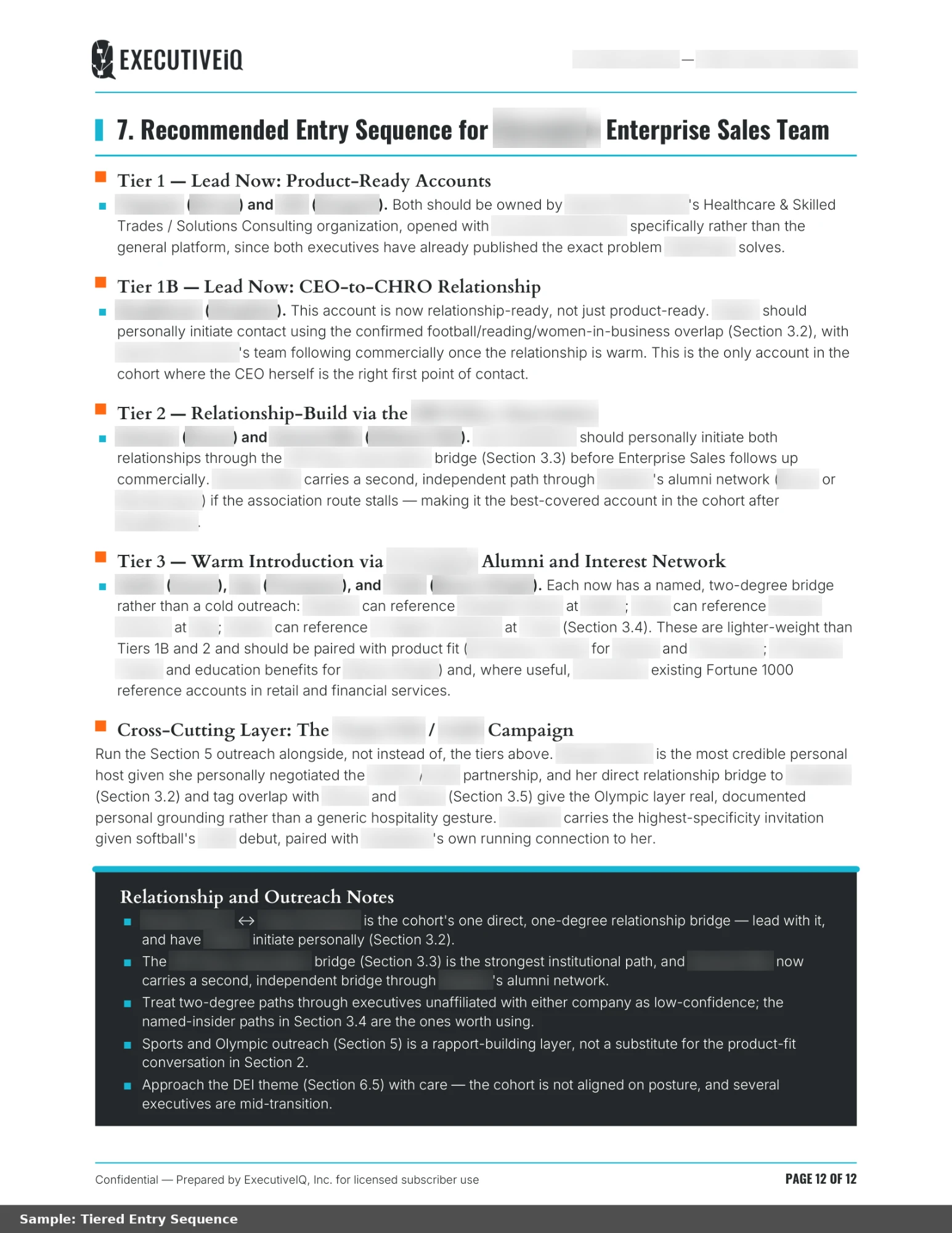
The event hospitality ran alongside all four tiers as a relationship-warming layer — not a substitute for the product conversation, but a way to accelerate it with something personal and genuine.
The Data Was Already There
Every insight in that playbook came from information that already existed in ExecutiveIQ’s profiles. The career histories, the interest tags, the board affiliations, the relationship paths, the business priorities drawn from earnings calls and SEC filings — all of it was already assembled, verified, and current. No one had to Google anybody. No one had to cross-reference LinkedIn with a proxy filing. No one had to wonder whether a CHRO who’s never been quoted has anything useful in their profile (they do — because we built it from the company’s own disclosures, not from the executive’s own megaphone).
That’s the difference between data and intelligence. Data is a profile. Intelligence is knowing that your CEO and their CHRO both played the same sport, serve adjacent causes, and are dealing with the same workforce problem — and that the shortest path between them runs through a trade-association committee where your strategy officer already has a seat.
A Preview of What’s Coming
Today this workflow means exporting EIQ profiles and running them through an AI tool like Claude. It works but it’s a manual step.
We’re building it so you won’t need that step. The playbook capability is coming directly into ExecutiveIQ — and through a native AI integration — so you’ll go from “I have a guest list” to “I have a strategy” without leaving the platform.
The profiles are already there. The relationship graph is already there. The priority data is already there. We’re just closing the last mile between the intelligence and the action.
ExecutiveIQ provides the executive intelligence that no AI tool can build on its own — verified profiles, relationship mapping, and cohort-level analysis on Fortune 500 and Global 2000 leadership.