
The Discipline That Has No Department
There is no degree in executive engagement. No certification. No global association. No annual conference where thousands of practitioners gather to compare notes.
And yet.
The people who do this work — who orchestrate relationships between their company’s leadership and their customers’ leadership — are some of the most strategically important people in the enterprise go-to-market engine. They sit at the nexus of sales, marketing, events, customer success, and executive programs. They manage four audiences simultaneously:
- the customer executives they’re engaging
- their own internal executives they’re deploying
- the sales teams they’re enabling
- and the marketers allocating budget to exclusive (and expensive) CXO events and executive briefings
One practitioner described the role as “a combination of speed dating, air traffic control, and operational excellence.” Another called it a giant puzzle.
They are also, very often, alone.
Where Does Executive Engagement Actually Live?
When we started hosting intimate gatherings of executive engagement practitioners — no slides, no panels, just honest conversation among people who live this work — we asked attendees a few questions beforehand. The answers confirmed what we’d been hearing and pointed to something bigger.
We asked: Where does executive engagement sit within your organization?
Only 14% said their company has a dedicated EE function. The rest are scattered. 29% report to the C-Suite or Office of the CEO because someone at the top recognized the strategic importance and pulled it close. Another 29% said EE is distributed across the organization, meaning no single team owns it. The remainder sit in marketing or sales, doing EE work inside a role that’s officially called something else.
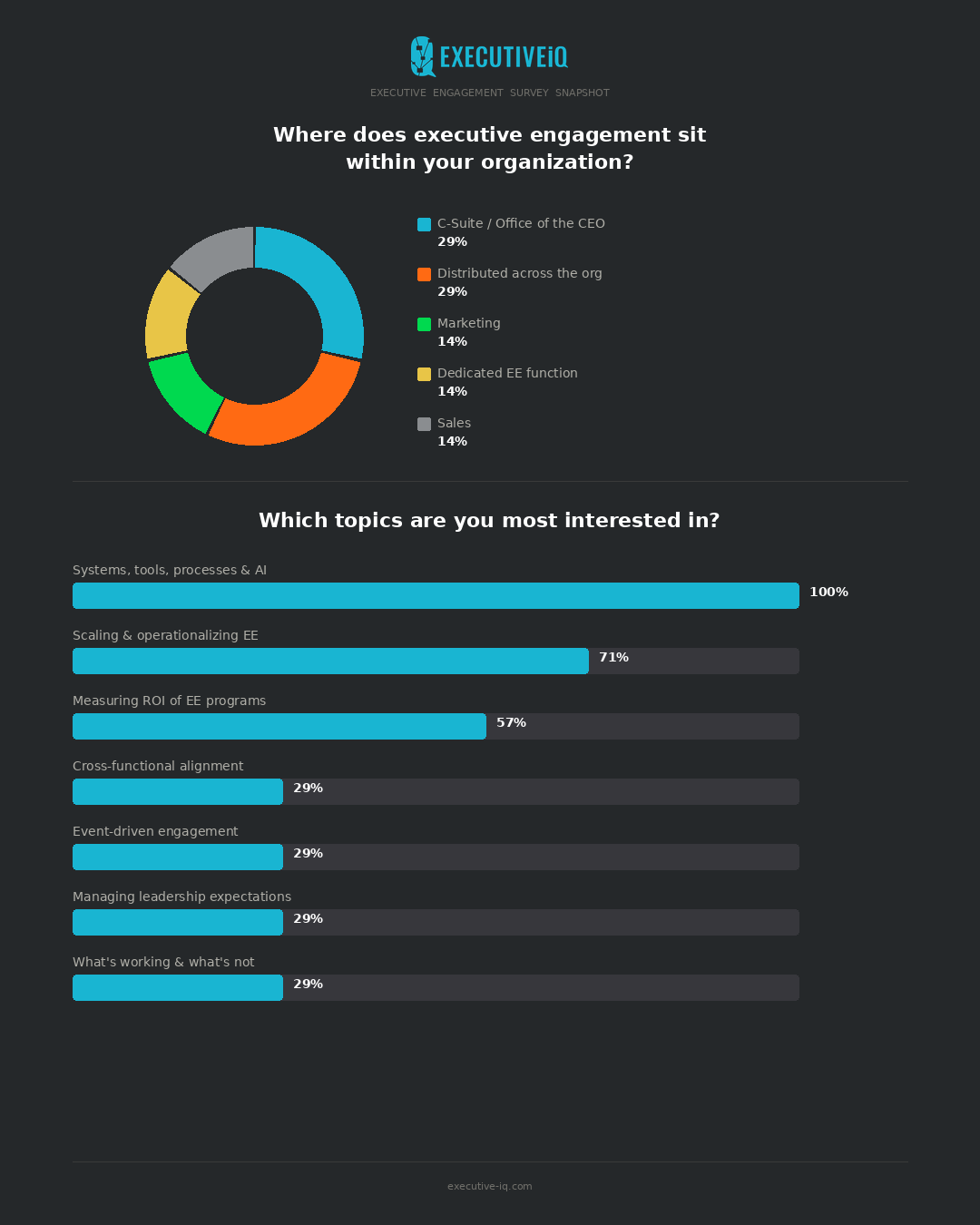
The two biggest responses were a tie: the very top of the house, and everywhere at once.
That’s executive engagement in 2026. It either lives at the CEO level or it has no single home — parceled out across the very functions it’s supposed to connect: sales, marketing, events, executive programs. And the people doing the work navigate that fragmentation every day, translating between departments that each own a piece of the executive relationship but none own the whole.
The organizational ambiguity runs deeper than reporting lines. Executive briefing programs — often the most visible expression of EE — are typically funded by marketing. But the relationships they’re designed to build are owned by sales. The strategic orchestration required to make them work cuts across both, plus customer success and executive programs. The budget lives in one place. The relationships live in another. The practitioner lives in between.
One practitioner summed up her entire career as “bridging connections with executives regardless of what my title is.” She’s done it from the sales side and the marketing side. The work was always the same. The org chart box kept changing.
What Practitioners Are Actually Hungry For
We also asked what topics they most want to dig into.
Every single respondent put “systems, tools, processes and AI” at the top of the list. Not event planning. Not content strategy. Infrastructure. These are seasoned practitioners who know how to do the work. What they don’t have is the scaffolding to do it at scale without personally holding every thread.
71% want to know how to scale and operationalize executive engagement. They’ve proven the concept. They’ve delivered results. Now they’re hitting the wall every EE practitioner eventually hits: how do you systematize something that is fundamentally about human relationships and highly orchestrated, bespoke moments?
57% said measuring ROI is a top interest. Not because they doubt the value — they’ve seen it up close. But because they need the ammunition to prove it internally. And 29% named managing leadership expectations, which is a polite way of saying: How do I keep my own executives committed when they want results faster than the work allows?
These aren’t people looking for a beginner’s guide. They’re looking for each other.
The Belief Problem
Here is the single biggest critical success factor for executive engagement, and it has nothing to do with tools or event strategy or CRM hygiene:
Your own executive team has to believe this is important and that it works.
That belief is not a given. It has to be won — often by the practitioner alone — in an organization that defaults to measuring everything in quarterly pipeline. Executive engagement doesn’t operate on that timeline. The relationships that drive the largest deals and the deepest account penetration are built between transactions in side conversations at summits, over dinners, on the golf course. Those moments don’t map to a CRM stage. They are, by design, the opposite of transactional.
So the EE practitioner isn’t just orchestrating across sales, marketing, events, and executive programs. They’re simultaneously the chief evangelist for the idea that the work connecting all of those functions matters. They’re running a discipline whose success depends on organizational conviction they have to build themselves, on a timeline that doesn’t match anyone else’s, with no professional infrastructure to point to and say: This is a recognized field. Here’s how other companies invest in it. Here are the benchmarks.
That is a lonely place to operate from. And it’s why the best EE practitioners share a trait that has nothing to do with event logistics or relationship mapping: they are relentlessly, almost stubbornly, convinced that tiny details and carefully orchestrated moments are the difference between winning and losing at the executive level. Not everyone across the go-to-market engine shares that conviction. The practitioner has no choice but to hold it, because the entire practice falls apart without it.
A Discipline That Deserves a Community
Executive engagement will never be a mass profession. The work requires a rare combination: genuine curiosity about people, comfort operating across organizational boundaries, the patience to play a game measured in years, and the ability to translate all of that into language that earns budget from a CMO and credibility with a sales leader in the same meeting.
But the practice is maturing. More companies are creating dedicated roles, pulling EE out of the patchwork of sales, marketing, and events and giving it a seat of its own. More leaders are recognizing that the difference between a stalled enterprise deal and a closed one is often the quality of the executive relationships behind it. And the practitioners themselves are starting to find each other — in small rooms, in honest conversations, in the growing recognition that this work is too important to keep distributing across four departments with no one accountable for the whole.
What EE doesn’t have yet is infrastructure. A shared body of knowledge. A place where the practitioner running programs at a Fortune 100 company and the one building an EE function for the first time at a Series D startup can compare notes and push the practice forward together.
That’s the gap we’re stepping into. Through the practitioner lunches we’re hosting in cities around the country, through the deep executive intelligence we publish here, and through this newsletter — a place to surface the insights, the patterns, and the hard-won wisdom that executive engagement practitioners have been carrying around individually for too long.
If you do this work in any form, under any title, we want to hear from you. Because the discipline exists. And it’s time it had a home.